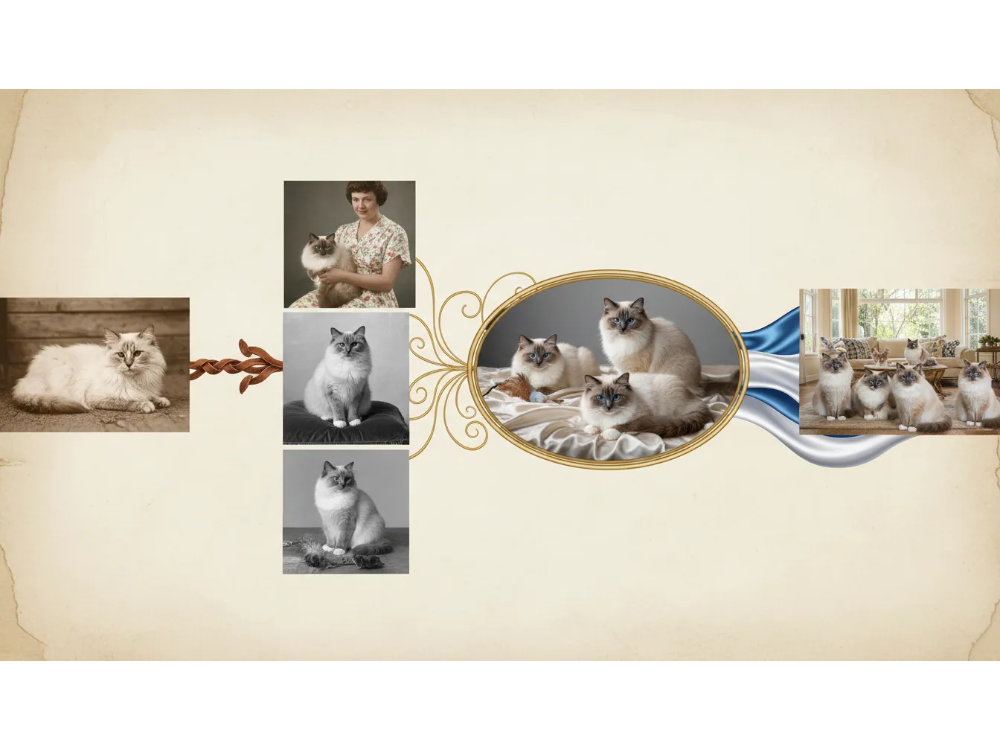
The Ragdoll breed history is perhaps the most colorful and debated saga in the feline world. While most pedigreed cats have origins rooted in natural selection or ancient lineages, the Ragdoll was “engineered” in the suburbs of Riverside, California, during the early 1960s..Their goal was to get the Ragdoll accepted by major registries like the CFA (Cat Fanciers’ Association) and official Ragdoll breed standards recognized by TICA (The International Cat Association).
The Origin Story: Josephine and the Riverside Mystery (1963)
The story begins with a woman named Ann Baker and her neighbor’s cat, Josephine. Josephine was a white, non-pedigreed “Angora-type” domestic longhair. Initially, she was described as a semi-feral cat with a standard, independent temperament. However, everything changed after a traumatic car accident.
The “Car Accident” Myth vs. Scientific Reality
Ann Baker famously claimed that after Josephine was injured by a car and treated at a local university, her genetic makeup was “altered.” Baker suggested that this trauma resulted in kittens that were:
-
Exceptionally Docile: Going limp like a “Rag Doll” when handled.
-
Pain Immune: Having a higher threshold for physical discomfort.
-
Human-Centric: Showing a dog-like devotion to their owners.
The Reality Check: While the car accident occurred, modern genetics confirms that trauma cannot alter a cat’s DNA to change the temperament of her future offspring. In reality, Baker was a brilliant breeder who recognized Josephine’s naturally docile traits and used selective breeding to stabilize these characteristics. She chose the most relaxed kittens from Josephine’s litters to build the foundation of the breed.
Why the name “Ragdoll”?
Baker coined the name in 1965 to describe the breed’s most famous trait: the tendency to relax all muscles and go completely limp when picked up. This “floppy” nature became the hallmark of the breed, distinguishing it from all other long-haired cats of the era.
The “Foundation Four”: Mapping the Ragdoll Pedigree
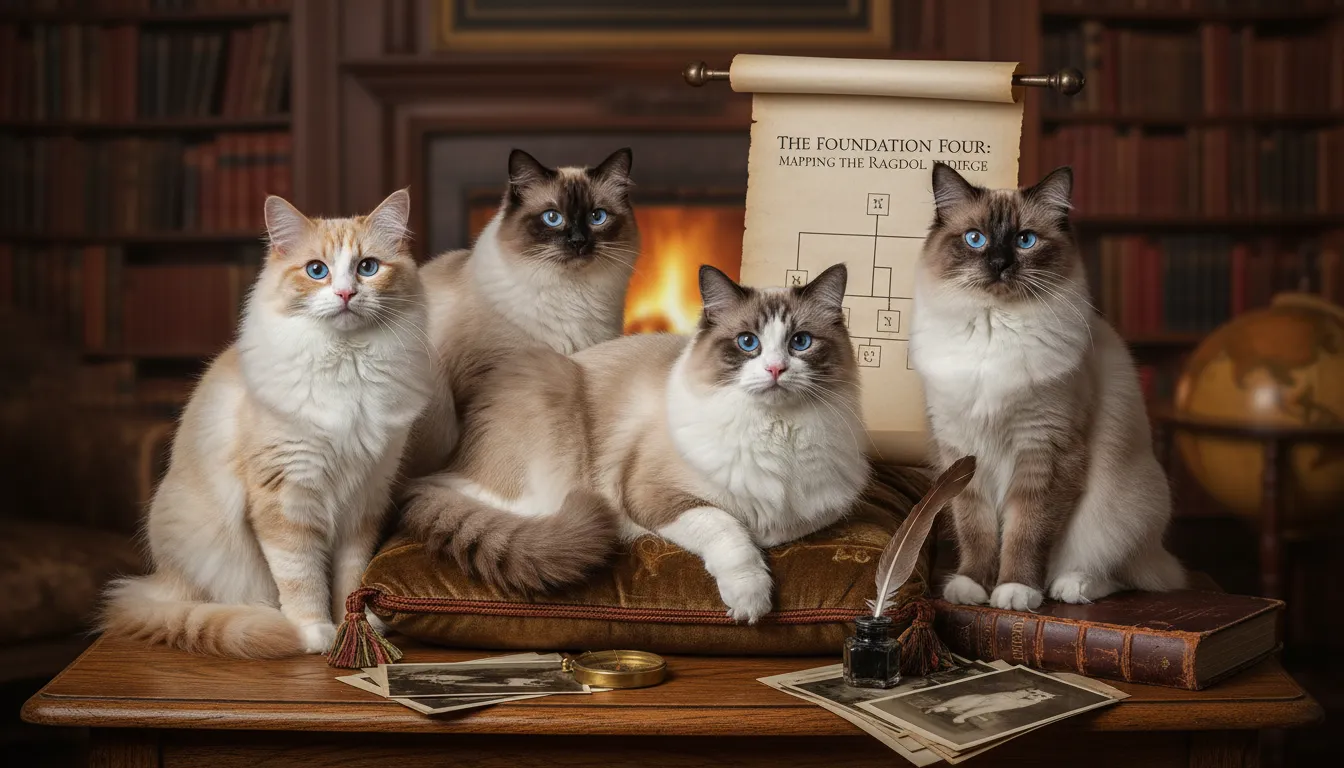
To truly understand the Ragdoll breed history, we must look at the specific cats that built the DNA of the breed. Ann Baker didn’t just rely on Josephine; she utilized four key felines to lock in the “floppy” genes and the signature pointed look.
The Ancestral Blueprint
Every authentic Ragdoll today traces its lineage back to these four foundation cats. They represent the genetic “Big Bang” of the breed.
| Cat Name | Physical Appearance | Historical Role | Key Contribution |
| Josephine | White Angora-type | Foundational Queen | The source of the “floppy” and docile personality. |
| Daddy Warbucks | Seal Mitted (Birman look) | Foundational Stud | Registration #66-0577-6: The first cat registered as a “Ragdoll.” |
| Fugianna | Seal Point Bicolor | “Light Side” Queen | Established the bicolor pattern and the “light” lineage. |
| Buckwheat | Black Self / Burmese-type | “Dark Side” Queen | Provided the sturdy size and deep color density. |
The “Light Side” vs. “Dark Side” Strategy
Ann Baker utilized a unique breeding theory that separated her cats into two groups based on their lineage from Josephine’s daughters:
-
The Light Side: Descendants of Fugianna. These lines were focused on producing the striking bicolor pattern—the white inverted “V” on the face that is so popular today.
-
The Dark Side: Descendants of Buckwheat. These lines were crucial for maintaining the breed’s large, muscular frame and the mitted/colorpoint patterns.
By crossing these two sides back to Daddy Warbucks, Baker solidified the breed’s “Look”: brilliant blue eyes, a rabbit-soft coat, and a massive, gentle body.
The First Registered Ragdolls (Dec 30, 1966)
The official history reached a turning point on December 30, 1966, when the first four cats were formally registered with the National Cat Fanciers Association (NCFA):
- Daddy Warbucks
-
Fugianna
-
Tiki (Seal Colorpoint)
- Kyoto (Seal Mitted)
The IRCA Era: When Ragdolls Were a Patented Business
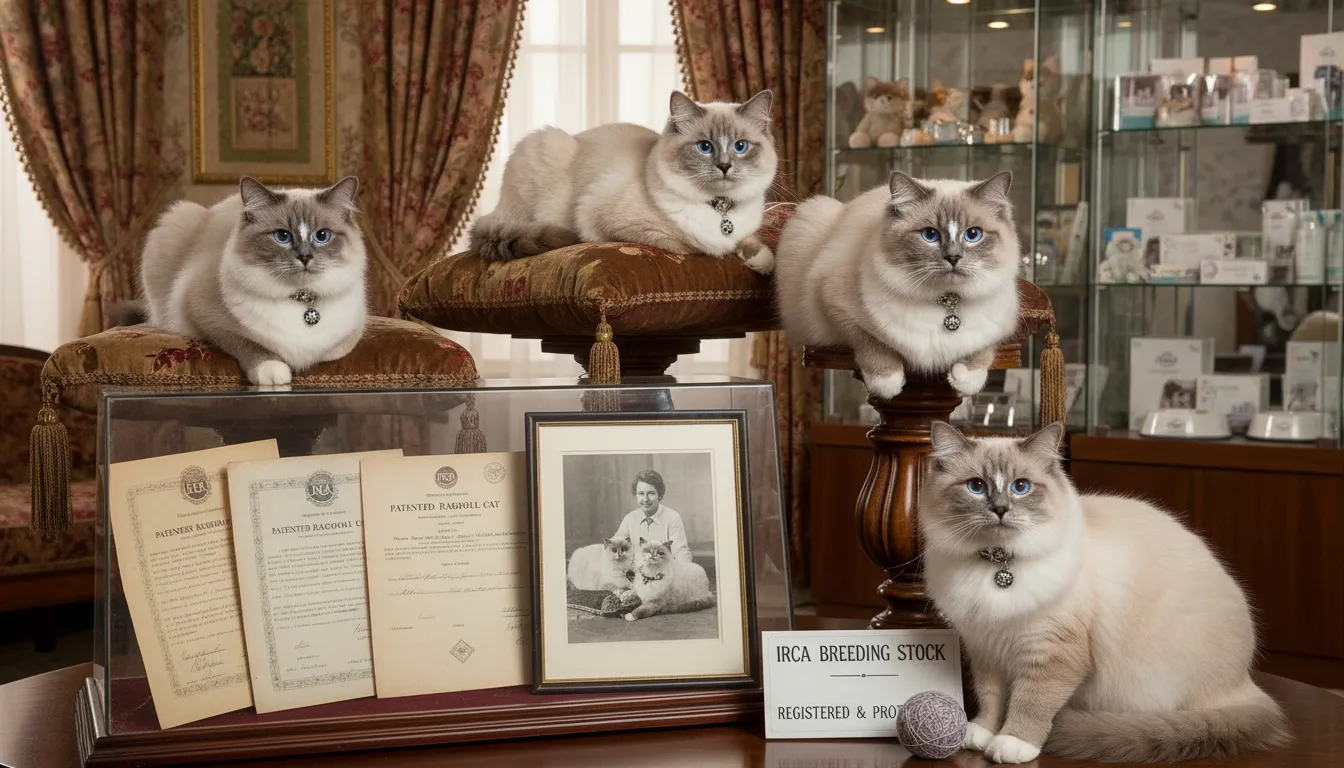
By the early 1970s, the Ragdoll was no longer just a local curiosity; it was a growing brand. However, Ann Baker was a protective founder who viewed the breed as her intellectual property. This led to one of the most unusual chapters in Ragdoll breed history: the era of the franchise.
The International Ragdoll Cat Association (IRCA)
In 1971, Ann Baker founded the International Ragdoll Cat Association (IRCA). Unlike traditional cat registries (like the CFA or TICA), the IRCA was designed as a business model. Baker wanted to maintain total control over how “her” cats were bred, sold, and marketed.
The 1975 Patent (#1026916)
In a move that remains unique in the history of domestic animals, Ann Baker successfully obtained a patent for the Ragdoll breed on December 19, 1975. This meant:
-
Royalties: Breeders who purchased cats from Baker had to pay a royalty fee for every kitten they sold.
-
Strict Licensing: Breeders were essentially “franchisees.” They had to follow Baker’s specific breeding rules or face legal action.
-
Isolation: IRCA-registered cats were not allowed to be registered with mainstream cat associations. This effectively isolated the breed from the rest of the “official” cat-fancy world for years.
The Trademark Legacy
Baker also trademarked the name “Ragdoll.” This trademark remained in effect for decades, creating a legal minefield for any breeder who wanted to work with the cats outside of her control. It wasn’t until the trademark expired (and the patent ran its course) that the name truly belonged to the public and the worldwide community of breeders.
Legal & Trust Intent: It is important for modern owners to understand that today’s “Standard” Ragdoll is a result of the breeders who eventually left this restrictive system to focus on health and international standards rather than a business franchise.
The Great Rebellion: How the Daytons Saved the Breed
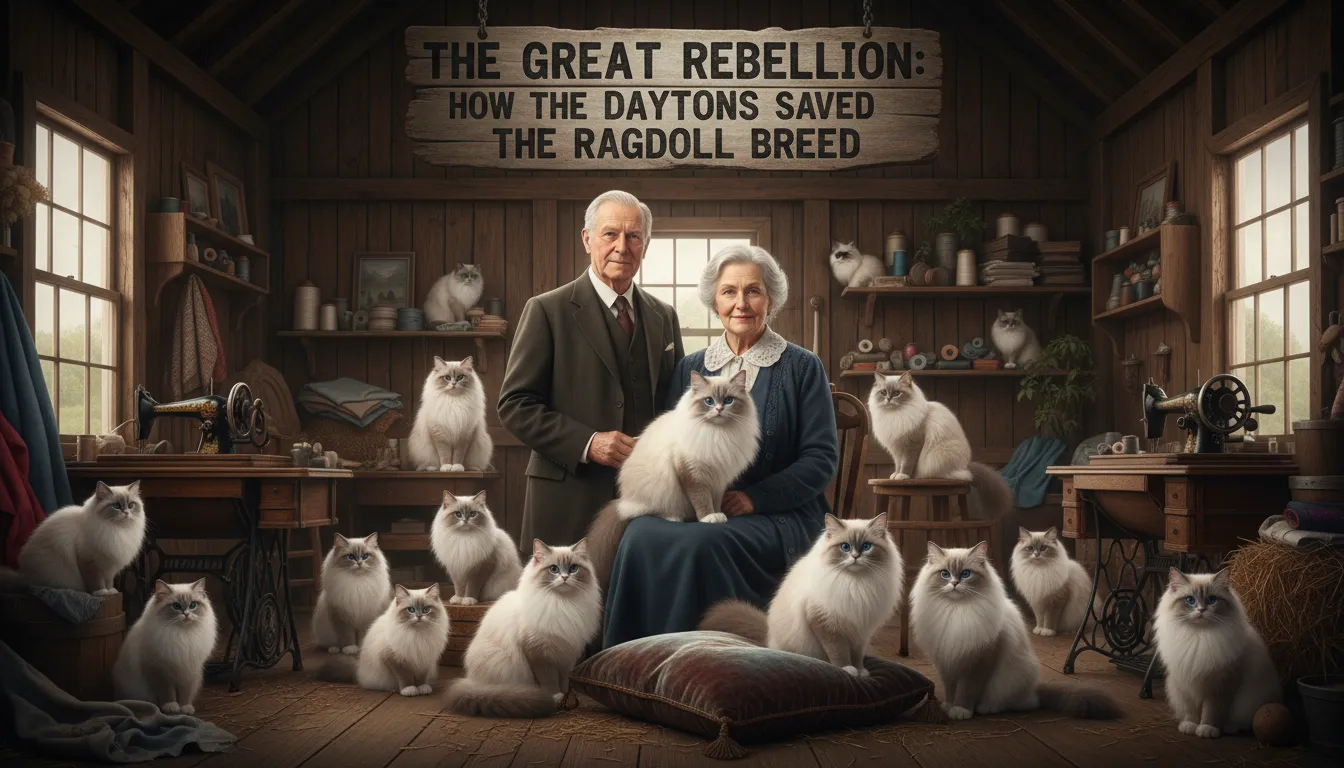
As Ann Baker’s IRCA franchise grew increasingly restrictive, a movement was brewing among early breeders who prioritized the welfare and formal recognition of the breed over a business model. This “rebellion” is what eventually transitioned the Ragdoll from a patented experiment to a globally recognized pedigree.
Denny and Laura Dayton: The Pioneers of Progress
In 1969, Denny and Laura Dayton purchased two cats from Ann Baker: Raggedy Ann Buddy and Raggedy Ann Rosie. Breeding under the prefix “Blossom-Time,” the Daytons became the most influential figures in modern Ragdoll breed history.
Unlike Baker, the Daytons focused on:
-
Scientific Pedigree Tracking: They created the first rigorous genealogical records for the breed.
-
Genetic Health: They moved away from the “alien” myths and focused on stabilizing the breed’s physical and mental traits.
-
Mainstream Recognition: Their goal was to get the Ragdoll accepted by major registries like the CFA (Cat Fanciers’ Association) and TICA (The International Cat Association).
The 1981 UK Expansion
The global spread of the Ragdoll is largely credited to the Daytons’ Blossom-Time lines. In 1981, the breed crossed the Atlantic when Pat Brownsell and Lulu Rowley imported eight cats from the Daytons to the United Kingdom.
This move was pivotal. By 1987, the British Ragdoll Club was founded, and by 1990, the breed achieved official recognition from the GCCF (Governing Council of the Cat Fancy).
The IRCA Split and the Birth of the Ragamuffin
The tension between Ann Baker and the independent breeders eventually led to a total fracture in 1994. Because Baker still held the trademark for the name “Ragdoll,” a group of breeders who broke away were forced to rename their cats. This led to the creation of a separate breed: the Ragamuffin.
While they share a common ancestor in Josephine, the two breeds diverged here:
-
Ragdolls: Focused on the pointed, blue-eyed standard established by the Daytons.
-
Ragamuffins: Allowed for more coat colors and patterns (including white patches and various eye colors).
Historical Gap Fill: Most competitors forget to mention that the Ragamuffin is actually a direct “sibling” of the Ragdoll, born out of this specific legal battle.
The Science of “Floppy”: Why Do Ragdolls Go Limp?
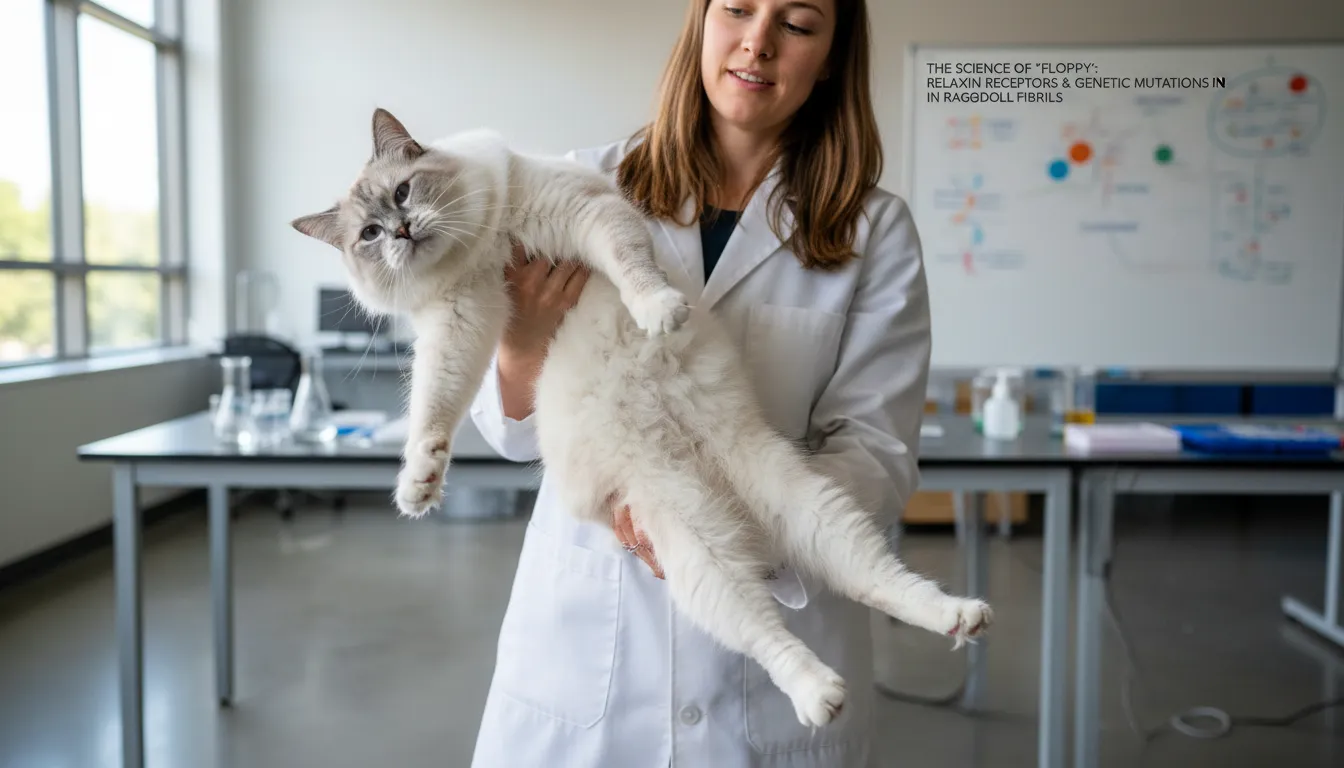
One of the most enduring parts of Ragdoll breed history is the claim that these cats are “immune to pain” or “genetically modified” to be floppy. As the breed gained popularity, these myths became a safety concern for veterinarians and owners alike.
Debunking the “Pain Immunity” Myth
Ann Baker’s original marketing suggested that because of Josephine’s car accident, Ragdolls did not feel pain like other cats. This is factually incorrect. * The Reality: Ragdolls have the same nervous system as any other feline. They feel pain, cold, and discomfort.
-
The “Hock Reflex”: Their tendency to go limp is actually a manifestation of their extreme trust and a specific docile temperament that was selectively bred over decades.
-
Safety Note: Because they are so stoic and rarely complain, owners must be extra vigilant in checking for injuries or illness, as a Ragdoll may not “cry out” like a more vocal breed.
Modern Legacy: From Riverside to Taylor Swift
Today, the Ragdoll is no longer a “Californian secret.” It has consistently ranked as the #1 most registered breed by the CFA for several years running. This massive global success has been fueled by social media and high-profile celebrity owners.
The most famous modern Ragdoll is undoubtedly Benjamin Button, owned by global superstar Taylor Swift. Benjamin’s appearance in music videos and on magazine covers has introduced the “Ann Baker legacy” to a whole new generation of cat lovers, proving that the breed’s docile charm is its greatest enduring trait.
Conclusion: A Living Legacy of Docile Devotion
The Ragdoll breed history is a fascinating journey from a stray white cat in Riverside to the most popular feline on the planet. It is a story of eccentric founders, legal trademarks, and a group of dedicated breeders who fought to ensure the “floppy cat” became a healthy, recognized pedigree.
When you hold a Ragdoll today, you aren’t just holding a pet; you are holding sixty years of history—from Josephine’s mysterious kittens to the global icon we love today.
FAQ: Winning the Featured Snippet
Q: Who was the original founder of the Ragdoll breed?
A: The Ragdoll breed was founded by Ann Baker in Riverside, California, in 1963, starting with a foundation cat named Josephine.
Q: Are Ragdolls really immune to pain?
A: No. This is a myth from the breed’s early history. Ragdolls feel pain just like any other cat; they are simply more docile and stoic in their behavior.
Q: What is the difference between a Ragdoll and a Ragamuffin?
A: Both share the same history, but the Ragamuffin was created in 1994 when breeders broke away from Ann Baker’s trademarked “Ragdoll” name to breed cats with more color and pattern varieties.
Q: Why do they call them Ragdolls?
A: They were named by Ann Baker because of their unique tendency to go completely limp and relax their muscles when picked up, much like a child’s rag doll.